
Markets US
SpaceX plans to launch Google’s tensor processing units (TPUs) into low Earth orbit aboard a Falcon 9 rocket as part of Alphabet’s Project Suncatcher, marking a pivotal step toward space-based data centers. The Transporter-18 mission, scheduled for October 1, 2026, will test solar-powered AI infrastructure in space, leveraging Alphabet’s $82 billion stake in SpaceX. The initiative aims to explore scalable machine learning systems in orbit, where satellites could harness up to eight times more solar power than on Earth.
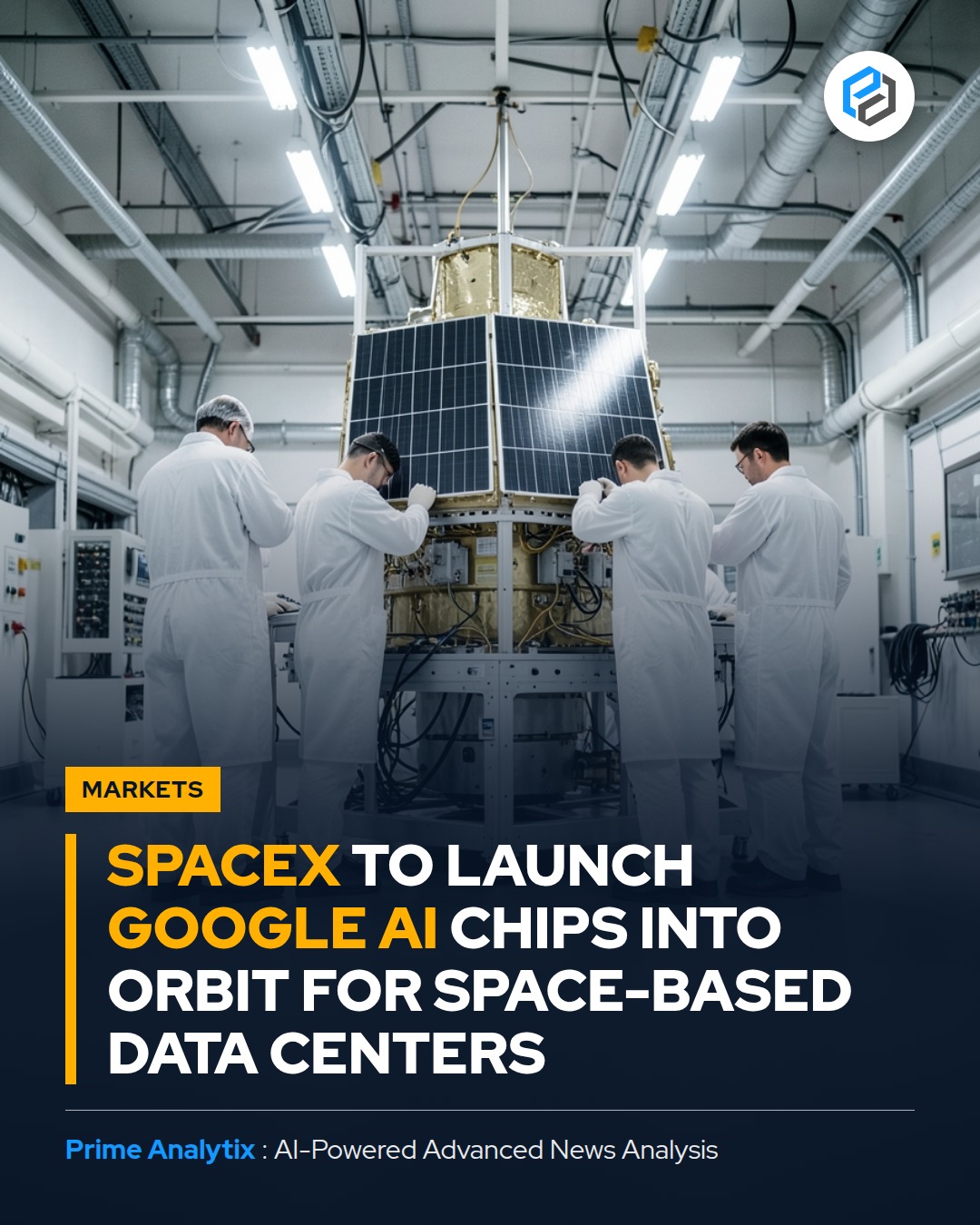
SpaceX and Alphabet’s collaboration aims to deploy AI computing infrastructure in space, with the Transporter-18 mission carrying Planet Labs satellites equipped with Google’s TPUs. The launch, set for 11:15 am PT on October 1, 2026, from Vandenberg Air Force Base, will test the feasibility of continuous AI workloads in low Earth orbit. Alphabet’s Project Suncatcher, a "moonshot" initiative first announced in November 2025, seeks to build solar-powered, radiation-resistant systems that could eventually link satellite constellations for distributed AI processing.
The partnership highlights the strategic convergence of AI and space technology, despite internal competition between Alphabet’s AI divisions and SpaceX. Alphabet’s $82 billion investment in SpaceX underscores the potential of orbital data centers, which Musk has called the "cheapest way to train AI" within three years. However, challenges like radiation shielding, cooling systems, and orbital debris remain unresolved, complicating the path to scalable space-based computing.
Stakeholders including Planet Labs, which deploys satellites with Google’s TPUs, and investors in both companies face opportunities and risks. While the initiative could redefine cloud computing by enabling continuous solar power, experts caution that rocket launch costs and regulatory hurdles may limit its feasibility. The mission also coincides with SpaceX’s concurrent astronaut delivery to the ISS, underscoring the company’s dual focus on commercial and scientific space ventures.
SpaceX will launch Google’s TPUs into orbit on October 1, 2026, alongside a mission to transport astronauts to the International Space Station, marking a dual focus on commercial and scientific space activities.
SpaceX and Alphabet’s push for space-based AI infrastructure represents a bold attempt to overcome terrestrial data center limitations, but success hinges on overcoming technical and regulatory challenges. The collaboration’s potential to redefine cloud computing remains uncertain, with unresolved issues like radiation resistance and orbital debris posing significant hurdles.
Topics: SpaceX, AI Infrastructure, Space-Based Data Centers, Alphabet, Google, Satellite Networks, Solar Power, Orbital Computing, Space Technology, Cloud Computing
#SpaceXLaunch #AIInSpace #SpaceDataCenters #GoogleAlphabet #OrbitalComputing #SatelliteNetworks
Source: CNBC
Post a Comment
Post a Comment