
Markets US
Intel's stock dropped 21% after the chipmaker issued weaker-than-expected fourth-quarter guidance, citing a 4% year-over-year decline in global PC shipments and a $600 million revenue loss from an Israel fab incident. The company reported third-quarter revenue of $16.51 billion, up 21% year-over-year, but client computing revenue fell 5% to $8.1 billion.
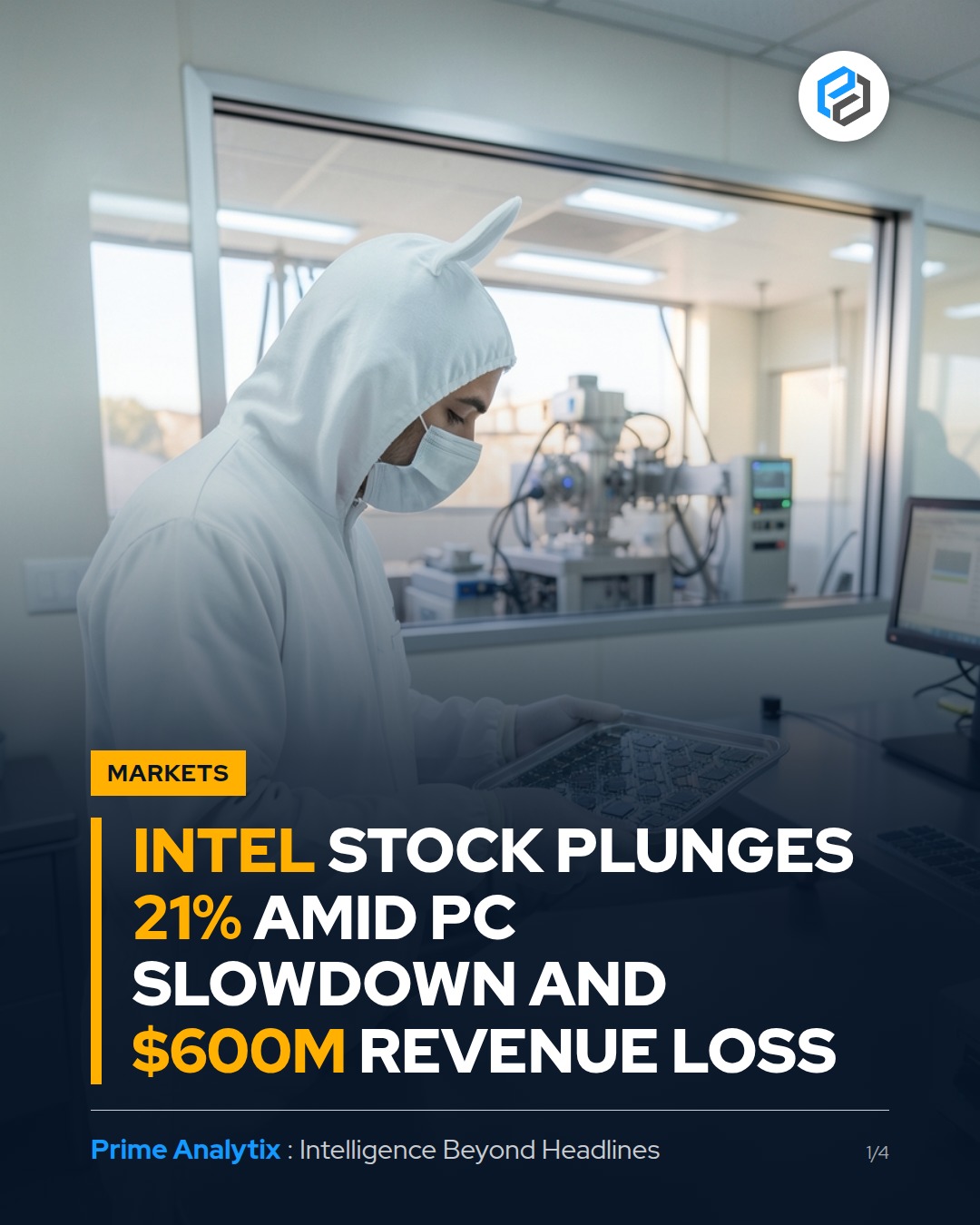
Intel attributed its weak guidance to ongoing PC market softness and a $600 million revenue hit from a fab incident in Israel. Third-quarter revenue reached $16.51 billion, up 21% from $13.7 billion a year earlier, but client computing and physical AI group revenue declined 5% year-over-year to $8.1 billion. Data center and AI revenue surged 78% to $7.3 billion, highlighting growth in emerging sectors. Global PC shipments dropped 4% year-over-year in the second quarter, exacerbating pressure on Intel's traditional markets.
The PC slowdown threatens Intel's long-term CPU demand, while its foundry business faces delays from the Israel incident, which could push back 10-nanometer chip shipments. However, strong data center and AI revenue growth may offset PC market weakness. Partnerships like the potential SK Hynix collaboration in Ohio and high-volume production at the Arizona 18A fab offer strategic alternatives to TSMC.
Investors, PC industry players, and competitors like NVIDIA and AMD are directly affected by Intel's guidance and supply chain disruptions. The company's cautious approach to foundry spending contrasts with rivals' aggressive strategies, potentially impacting its competitiveness. Risks include prolonged PC market weakness and delays in foundry expansion, while opportunities lie in AI growth and new customer acquisitions.
Intel's stock plunge underscores the tension between its AI-driven growth and struggling PC markets. The company's ability to scale its foundry business and navigate PC demand pressures will determine its long-term trajectory.
NVIDIA will report results in mid-November, while AMD will release its earnings next week. Intel plans to announce progress on its 14A chips in the next two quarters. The Ohio fab's first structural truss was installed last week, and Intel may unveil new customers for its Arizona chips in the same period.
Intel's stock drop reflects PC market headwinds, but its AI and data center growth offers long-term potential. The key uncertainty remains whether the PC slowdown will persist and how quickly Intel's foundry business can scale.
Topics: Semiconductor Industry, Chipmaker Performance, Data Center Growth, AI Revenue, Foundry Business, Semiconductor Competition, Equity Offering, PC Market Slowdown
#IntelStock #SemiconductorIndustry #DataCenterGrowth #AIRevenue #FoundryBusiness #PCMarketSlowdown
Source: CNBC
Post a Comment
Post a Comment