
Markets US
Ford Motor Co. reported third-quarter earnings that beat Wall Street estimates but missed revenue targets, narrowing its 2026 adjusted EBIT guidance to $10.5 billion–$11 billion. The company said 2027 earnings will align with 2026 results, signaling stability amid production and cost challenges.
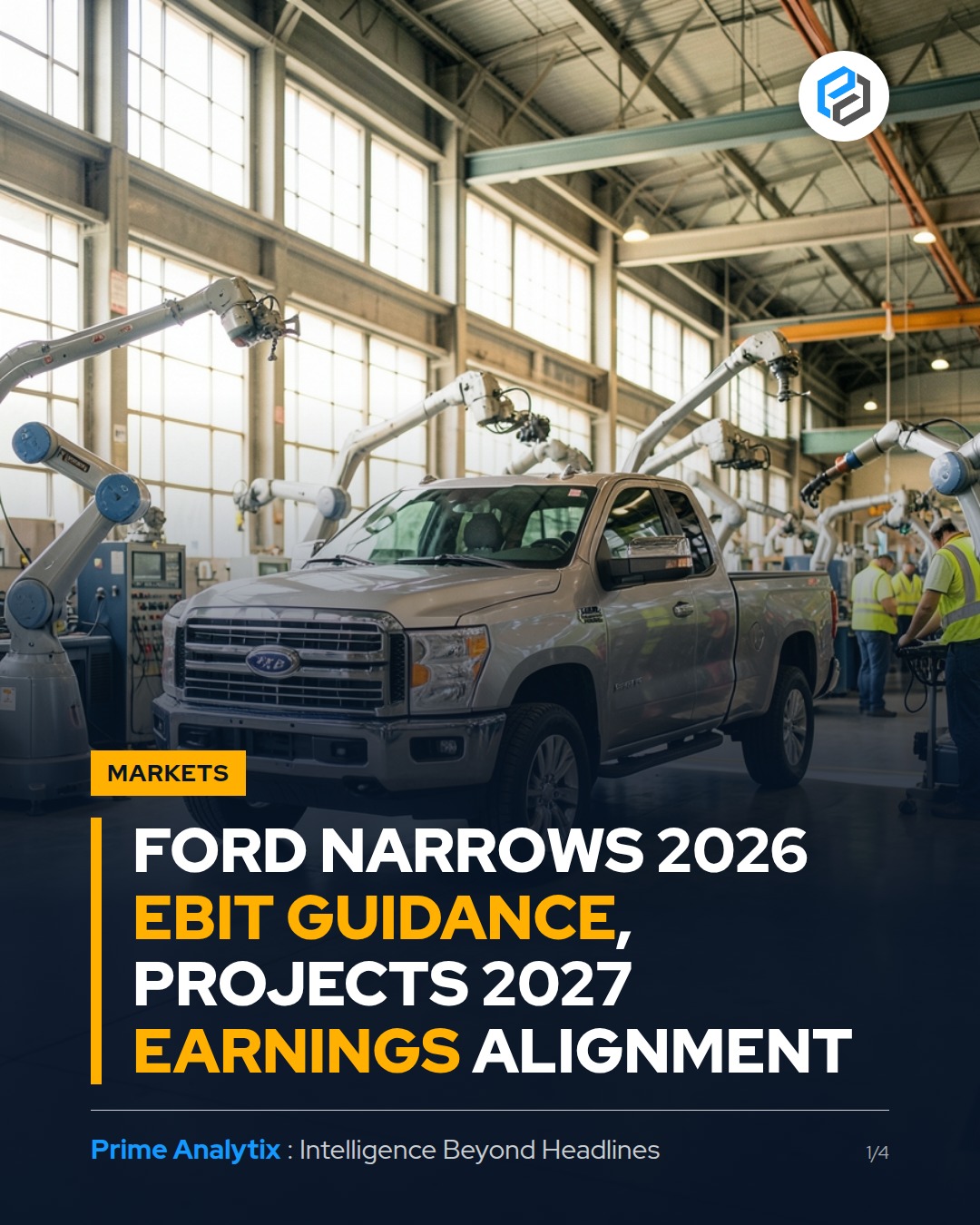
Ford’s third-quarter results showed mixed performance, with adjusted free cash flow reaching $4.7 billion—$2 billion above analyst forecasts—but automotive revenue fell slightly to $46.08 billion, below the $46.24 billion forecast. CFO Sherry House cited production stabilization efforts for F-Series trucks and offsetting factors like a $1.3 billion tariff refund as key drivers. The company narrowed its 2026 EBIT guidance to $10.5 billion–$11 billion, down from a prior range of $10 billion–$11 billion. Ford Blue’s pre-tax earnings are expected at $5.5 billion, near the top of prior guidance, while Ford Pro and Model e segments are projected to record $7 billion in EBIT and $4 billion in losses, respectively. Overall revenue declined 2% year-over-year to $49.5 billion, with net income dropping to $2 billion from $2.4 billion in the same period in 2025.
The 2027 earnings outlook suggests Ford’s focus on production stabilization and cost savings may stabilize margins, though rising commodity costs and supplier issues remain risks. The company’s Canada-produced F-Series Super Duty trucks in 2027 could offset lost production at F-150 factories, while new EV and redesigned model rollouts may drive future growth. However, missed revenue in Q3 reflects underperformance across all business units, including Blue, Pro, and Model e segments, raising concerns about balancing new model launches with existing unit performance.
Investors and competitors like General Motors and Tesla may reassess strategies as Ford’s 2026 EBIT guidance is tighter than prior expectations. Cost savings from warranty and material reductions are expected to extend to structural costs, improving long-term margins. However, alternative aluminum sourcing expenses and rising commodity costs could pressure margins, complicating Ford’s path to its 2029 EBIT margin target. Suppliers and customers may face shifts due to production adjustments and potential price changes from cost pressures.
Ford’s management faces pressure to meet margin targets, with structural cost reductions expected to extend into 2027. The company’s focus on production stabilization and cost management highlights progress, but the key uncertainty remains whether supply chain challenges and rising costs will hinder margin expansion toward its 2029 goal.
Ford plans to roll out next-generation EVs and Canada-produced pickups in 2027, continuing warranty and material cost-saving initiatives. Structural cost reductions are expected to extend into 2027, supporting its long-term margin goals.
Ford’s 2027 earnings outlook aligns with 2026 results, reflecting progress in production stabilization and cost management. The key uncertainty is whether rising commodity costs and supply chain challenges will prevent margin expansion toward its 2029 target.
Topics: Automotive, EBIT, Ford Motor, Financial Results, Cost Management, EVs, Supply Chain, 2027 Earnings, Production Stabilization, Margin Expansion
#FordResults #EBITGuidance #2027Earnings #EVRollouts #CostManagement #SupplyChainChallenges
Source: CNBC
Post a Comment
Post a Comment